Anthropos Edition
Academic book series for scholarship on education for special needs and social care from anthroposophic perspectives.
Founder and editor (2012–2016): Rüdiger Grimm. Editor (from 2017): Jan Göschel
Published in cooperation by Verlag am Goetheanum & Athena Verlag.
Gabriele Scholtes; Ferdinand Klein
«Die Frage nach dem Sinn»
Applied logotherapy in dialogue with anthroposophical social fields of action.
Anthropos Edition: Supportive education and social therapy from an anthroposophical perspective, edited by Jan Göschel
Year of publication: 2025
Verlag am Goetheanum
ISBN: 978-3-7235-1702-4
This publication is dedicated to examining Viktor Frankl's logotherapeutic approach in the context of anthroposophically oriented fields of action. It shows that meaning-centered logotherapy not only resonates with the anthroposophical understanding of the world and humanity in its internal structure, but also deepens and expands this understanding on a philosophical and existential level. The complementarity of both approaches creates a fruitful field of tension in which the search for meaning, freedom, and responsibility as central dimensions of human existence can be made therapeutically effective.
Jan Göschel; Rüdiger Grimm (Hg.)
«… ein fortwährender lebendiger Zusammenhang»
Contributions to Rudolf Steiner’s Curative Education Course
Anthropos Edition: Supportive education and social therapy from an anthroposophical perspective, edited by Jan Göschel and Rüdiger Grimm
Year of publication: 2024
Illustrations: with pictures
Verlag am Goetheanum
Digital open access publication (e-book)
ISBN: 978-3-7235-1702-4
The book «… ein fortwährender lebendiger Zusammenhang» is the joint work of a group of authors who, against the background of the time when the course was created and in reflection on the present situation, explore the future perspectives that can be gained from Steiner’s explanations.
Zusammenleben wollen
A portrait of three social therapy communities: reality, development issues and aspects of participation
Anthropos Edition: Supportive education and social therapy from an anthroposophical perspective, edited by Jan Göschel
Year of publication: 2023
Verlag am Goetheanum
ISBN: 978-3-7235-1743-7
The intention of an inclusive way of life is to want to live together. Researchers from the Youth Section of the School of Spiritual Science at the Goetheanum have been studying three inclusive communities in Germany for a long time with this intention in mind.
In regular exchanges between the research team and representatives of the three communities, the following research topics emerged:
- to explore the conditions of the social environment as a reality of life within communities and to make them communicable,
- to elaborate the developmental issues and impulses contained therein, and
- to sketch out the first attempt at a broader understanding of inclusion and self-determination in the context of anthroposophical communities, based on an overview and in-depth study of the forms of communal living that have been found.
The project documented in this volume explores the central themes of participation and inclusion in the contemporary issues of social change, social justice, and a jointly shaped human future.
Christiane Drechsler
Begegnungs-Räume
Encounters and relationships in inclusion partnerships
Alternative ways of shaping relationships in inclusive social spaces
Anthropos Edition: Supportive education and social therapy from an anthroposophical perspective, edited by Jan Göschel and Rüdiger Grimm
Year of publication: 2019
Verlag am Goetheanum
ISBN: 978-3-7235-1632-4
Social space development in connection with the Convention on the Rights of Persons with Disabilities generally has to do with creating accessibility, and thus opportunities for people with disabilities to participate in public spaces. Thus, at least in theory, opportunities arise for people with and without disabilities to meet. However, it is questionable whether encounters actually occur automatically through the mere use of shared social space: for too long, people with and without disabilities have lived in parallel societies.
The planning and implementation of a project for personal future planning in the leisure sector for people with intellectual and multiple disabilities in an inclusive housing project in northern Hamburg took a completely new approach. With the help of inclusion partners without disabilities and a support group of friends, parents, and other people from their social environment, the people with disabilities involved in the planning were able to (re)discover their interests and wishes. An important goal of the project was to show ways in which people with sometimes severe disabilities can organize their leisure time independently and individually. This was linked to the approach to social space development: by establishing opportunities for disabled and non-disabled people to spend their free time together, the Wulfsdorf neighborhood is to experience an improvement in the quality of living and leisure time.
Two series of interviews with the persons involved in planning, the inclusion partners, and the mentors were central to the scientific support. The evaluation of the interviews yielded some surprising results: it was not always about “more” services; just as important could be settling into one's new (and still relatively new) place of residence or building friendships. The aim and content of the book is to give those involved a voice: perhaps this example will serve as a help for starting similar projects in other contexts.
Pim Blomaard
Beziehungsgestaltung in der Begleitung von Menschen mit Behinderungen
Aspects of professional ethics in supportive education and social therapy
Edition Anthropos: Supportive education and social therapy from an anthroposophical perspective, edited by Rüdiger Grimm, vol. 3
2nd edition 2017
Verlag am Goetheanum
ISBN: 978-3-7235-1461-0
This book adopts the perspective of the professional carer who wants to shape their relationship with people with intellectual disabilities on the basis of equality and recognition. The dialogical principle is based on thinkers such as Buber, Steiner, Rogers, Mac Intyre and Haeberlin and is ethically evaluated with practitioners such as Gröschke, Theunissen, Köhn and Flosdorf. The author develops a virtue ethics that establishes disability care as a professional practice and presents exercises that caregivers can use to prove themselves in difficult situations. This is how a professional ethic is created that combines the image of humanity with the professional image. At the same time, the independent position of the person being cared for is taken into account, in that the carer contributes as a person and develops through the interaction. The asymmetrical relationship can thus be transformed into an equal one.
Bernhard Schmalenbach (Hg)
Dimensionen der Heilpädagogik
Development support, community building and inclusion | Festschrift for Rüdiger Grimm
Edition Anthropos: Supportive education and social therapy from an anthroposophical perspective, edited by Bernhard Schmalenbach, vol. 61.
Year of publication: 2016
Verlag am Goetheanum
ISBN: 978-3-7235-1571-6
This volume brings together a wealth of contributions from a range of topics and fields of work in supportive education: practical suggestions, explorations of the history of supportive education, community building and inclusion – in a dialogue between theory and practice and from a range of perspectives, including those of anthroposophical supportive education and social therapy. In this commemorative publication dedicated to Rüdiger Grimm, 23 authors provide reports on their experiences and food for thought.
Bernhard Schmalenbach
under collaboration with Sören Roters-Müller
Heilpädagogische Perspektiven auf das Alter
Suggestions for training and further education for people who work with people with disabilities
Edition Anthropos: Supportive education and social therapy from an anthroposophical perspective, edited by Rüdiger Grimm, vol. 51.
Year of publication: 2016
Verlag am Goetheanum
ISBN 978-3-7235-1561-7
ATHENA-Verlag
ISBN 978-3-89896-623-8
Bernhard Schmalenbach’s supportive education perspectives focus on the need for professionally sound assessments of the knowledge and skills that employees of supportive education institutions should possess in order to provide appropriate support for older people with disabilities.
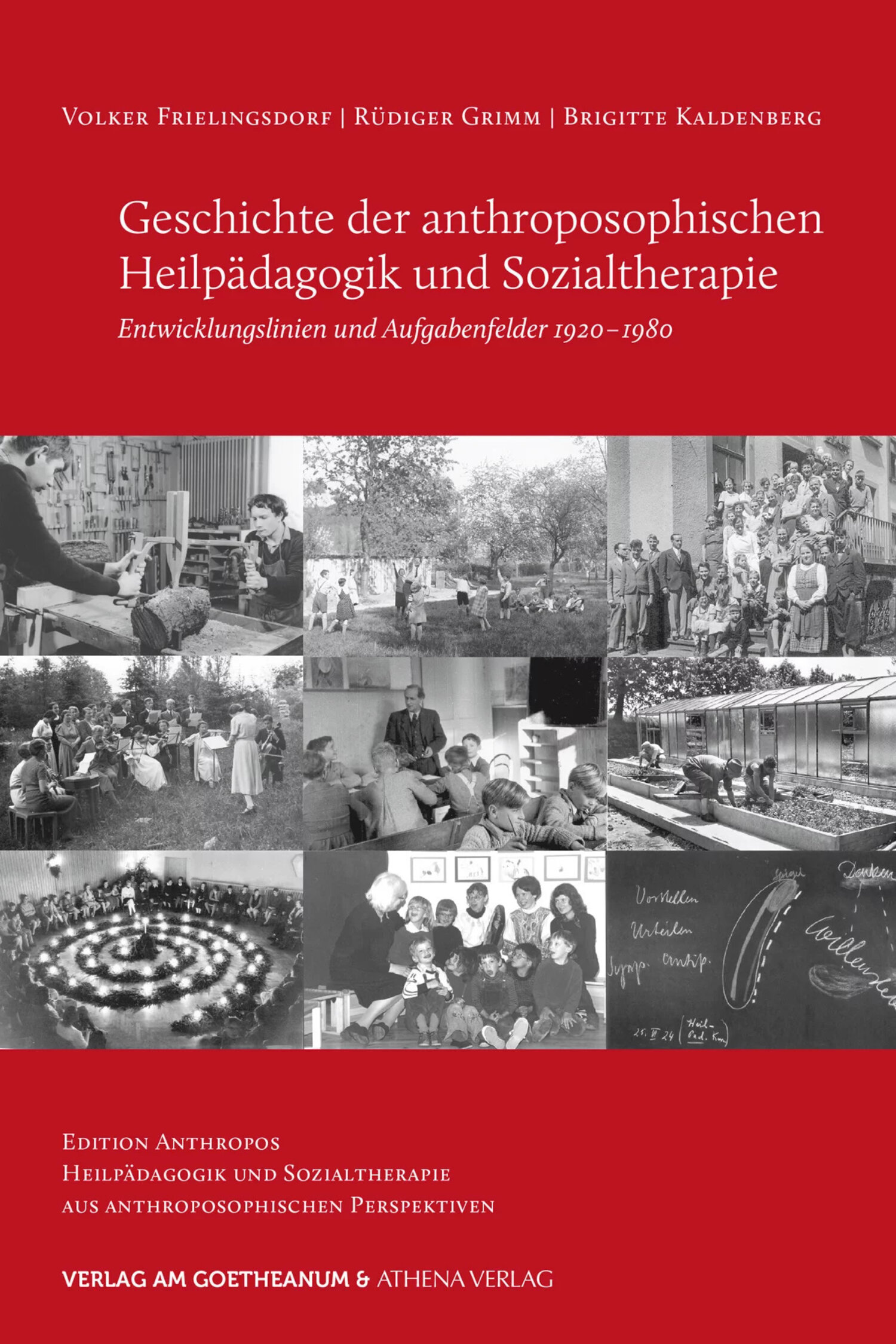
Volker Frielingsdorf; Rüdiger Grimm; Brigitte Kaldenberg
Die Geschichte der anthroposophischen Heilpädagogik und Sozialtherapie
Development lines and fields of endeavor 1920–1980
Year of publication: 2013
Verlag am Goetheanum
ISBN: 978-3-7235-1478-8
The history of supportive education and social therapy is not just a way of developing a holistic method of supporting and caring for children, young people and adults from the spiritual-scientific view of humanity in anthroposophy. It is also part of the history of the profession in its difficult path through the 20th century and beyond, an initiative movement in which the development of anthroposophy is also expressed in its eventful history.
Jan Christopher Göschel
Der biografische Mythos als pädagogisches Leitbild
Transdisciplinary funding planning based on the children’s conference in anthroposophical supportive education
Edition Anthropos: Supportive education and social therapy from an anthroposophical perspective, edited by Rüdiger Grimm, vol. 11
1st edition 2012
ISBN: 978-3-89896-492-0
E-book (2024)
Verlag am Goetheanum
ISBN: 978-3-7235-1772-7
In response to the instrumental rationality of a positivist disability education, the author develops a transdisciplinary approach to supportive education that uses the guiding principle of individual biography as an integral principle of the child’s life. This “biographical myth” is used as a model for pedagogical and therapeutic action that is committed to the integrity of the developing biography. By incorporating elements of phenomenology, hermeneutics, narrative and image theory, as well as contemplative humanities, the author creates an epistemological and methodological basis, along with a guideline for the practical design of transdisciplinary funding planning processes in the context of supportive and special needs education.
Andreas Fischer
Zur Qualität der Beziehungsdienstleistung in Institutionen für Menschen mit Behinderungen
An empirical study in connection with the QM procedure “Ways to Quality”
Edition Anthropos: Supportive education and social therapy from an anthroposophical perspective, edited by Rüdiger Grimm, vol. 21.
1st edition 2012
ISBN: 978-3-89896-493-7
E-book (2024)
Verlag am Goetheanum
ISBN: 978-3-7235-1771-0
Curative education and social therapy are essentially based on relationships between two people. These relationships carry the risk of one-sidedness, as the circumstances of those involved are different. One person needs help and support in coping with everyday life, while the other tries to provide this support and help.
The author examines the question of how to establish an adequate and dialogical relationship that enables people in need of support to achieve the greatest possible self-determination and autonomy. The point of reference here is the anthroposophically oriented understanding of human beings and the world. At the same time, a broad survey shows that the quality management process “Wege zur Qualität” (Ways to Quality) offers assistance in shaping relationship work in such a way that it takes into account the needs of people who require support and at the same time corresponds to the innermost concerns of anthroposophical curative education and social therapy.