
From Social Isolation to a Cultural Haven
“When you feel warmth in your heart, you remember us.” – A report on 20 years of “Blagoe Delo” in Russia
Report and photo: Brigitte Deck, June 2026
The social therapy day center “Blagoe Delo” (Good Cause) is located in Verkh-Neivinsk, a small town in the Sverdlovsk Region of the Urals, 70 km north of the university city of Yekaterinburg, on the border between Asia and Europe.
“Blagoe Delo” was established in connection with a training program in supportive education and inclusive education that began in Yekaterinburg in 2001. This was the result of a local initiative in collaboration with the East-West Group of the “Sofia” Association for Development Work in Järna and the Nordic Association for Supportive Education and Social Therapy (NFLS). Throughout all these years, we traveled to Yekaterinburg to teach and to support new projects initiated by students who had completed the three-year training program.
Vera Simakova, one of the directors of the training program, founded the social therapy facility “Blagoe Delo” in Verkh-Neivinsk, outside the closed city of Novouralsk, in 2005. It was located in a half-ruined house without any social support. With the help of the Nordic Association for Supportive Education and Social Therapy in Sweden, as well as foundations and support associations from Germany and the Netherlands, the house was purchased and gradually renovated. The fact that the seminar – now focusing on integrative education – took place at the site of the practical establishment was a great benefit for everyone at Blagoe Delo as well.
Between 2004 and 2015, four groups from the seminar traveled to Järna to participate in the Nordic Study Days for Supportive Education and Social Therapy. This also made it possible to take study visits to various facilities in the surroundings of Järna, which became an unforgettable experience and a highlight of their three-year training program. Most of the costs were covered by the Nordic Association for Supportive Education and Social Therapy.
Through our training activities, we also established new connections with the cities of Nizhnevartovsk and Surgut in Siberia, where conferences and seminars were organized. This cross-continental exchange led to unforgettable encounters and friendships between people from vastly different worlds and cultures.
Since 2015, the training program has been conducted in collaboration with the University and the Rudolf Steiner University in Norway, as well as the Ural State Pedagogical University in Yekaterinburg.
Over the course of its 20-year history, "Blagoe Delo" has increasingly become a cultural haven for people with various disabilities, war victims, socially isolated individuals, and those with a criminal past. Right from the start, in addition to the first woodworking and textile workshops, a theater studio was established where these individuals learned to express their thoughts and feelings in words and gradually began to portray characters from classic Russian fairy tales and stories.
Right at the beginning, in the autumn of 2005, I met these people in that dilapidated house. They sat huddled together in a circle, like shadows of their former selves, unable to communicate with one another, with a burning candle in the middle. After just three years, we were able to invite those same people to join us in Järna for the “Midsommarmöte,” where people with special needs from all the Nordic countries regularly gather for a festive celebration. Our friends from the Urals arrived wearing costumes they had made themselves and performed a story about their homeland as a play.
Over time, between 60 and 70 young people, adults, and individuals facing difficult life circumstances found the opportunity to pursue a meaningful and dignified life at Blagoe Delo. Gradually, additional workshops, an orchestra, and a large vegetable and flower garden were established. In the space of just a few years, these individuals blossomed into people who radiated a zest for life and self-confidence, and they increasingly became staff members. Some of them were also regularly involved in the practical component of the seminar.
Many of them toured as participants in the theater studio, traveling as far as Moscow. They also traveled to Norway and Austria to attend conferences there. Through theater tours, markets, and festivals, a new sense of openness emerged – both locally and regionally – in a country where it is still not taken for granted that the weakest and most vulnerable members of society have a right to education, culture, care, and humane treatment. “Blagoe Delo” was presented to audiences who applauded, cried, or protested. These cultural and informational festivals were held in various districts across Russia. “Blagoe Delo” was featured on television and received coverage in newspapers and at press conferences. When they won the award for the second-best social project in Russia in 2014 and the award for the best project in 2015, they became known throughout the country.
This marked the beginning of a collaboration with the political and administrative leadership of the Sverdlovsk Region, which led to "Blagoe Delo" being selected as a pilot project for the entire region. Vera Simakova, the director of “Blagoe Delo,” who was elected to the Governor’s Council, conducted a training program for 20 leaders of social institutions in the region. This was done in collaboration with the Department of Social Services and several Blagoe Delo staff members. The project was led by Petter Holm (NO), a member of the International Training Circle of the Section for Inclusive Social Development.
In November 2012, “Blagoe Delo” organized the second Russian Congress for People with Support Needs in Yekaterinburg in collaboration with the Sverdlovsk Department of Social Affairs and the Russian Association for Supportive Education and Social Therapy. The event was attended by 250 participants from 15 regions of Russia.
Throughout this entire period, Blagoe Delo had to fight for its survival. Whenever they sought government support, they were told: “If you want to work with these people, funding is your own problem.” Over the years, many foundations, institutions, and private individuals from the West have contributed to Blagoe Delo’s survival and development. The seminar and the dissemination of expertise to other regions would not have been possible without the support of the Nordic Association for Supportive Education and Social Therapy. More than 700 social workers and students have completed the seminar and other courses over the past 20 years.
In 2010, “Blagoe Delo” received its first small grant from the Russian government. In addition, the organization must continue to apply to foundations or charitable organizations for support for individual projects. The organization generates a small amount of income through the sale of products made in its workshops, through larger orders, and through participation in markets.
There were times when the kitchen had to be closed because there was no money to pay the electricity bills. Sometimes wages were several months in arrears, and half the staff had to be laid off. Despite all the difficulties, there was always an unyielding determination to fight for equality for all people and to continue spreading this message.
For several years, “Blagoe Delo” was busy preparing for the first World Congress for Persons with Disabilities in Yekaterinburg in 2017. This was made possible through collaboration between civil society and government bodies: Thomas Kraus (DE), Vera Simakova from “Blagoe Delo” (RU), and Petter Holm (NO), in cooperation with the governor and the minister of social affairs in Sverdlovsk. The entire organization of this massive project took place in a small, renovated log cabin at Blagoe Delo! More than 700 participants from 29 countries around the world attended. Those who had traveled the farthest – from New Zealand – were greeted with a special round of applause. Approximately 1,300 visitors attended the opening ceremony at the large sports palace. Anyone who had thought the mood would be subdued, given the presence of so many people with a wide variety of challenges, was thoroughly mistaken. From the very first moment, this imposing building was filled with joy, creativity, and social commitment. Even during the opening ceremony, we saw examples of participants surpassing themselves – they took the stage in wheelchairs and with prosthetics to perform excellent dance and acrobatics. Every morning, different groups introduced themselves with artistic performances such as music, dance, singing, acting, painting, and more. During the panel discussions, the focus was not on what society should do for people with disabilities, but rather on what they can do for society: “We must struggle with our challenges and, in doing so, develop skills that we can contribute to our society.” – “We must also be able to help, not just expect help.” – “You yourself are responsible for your own happiness.” – “I don’t have legs, but I can stand up for my convictions and my rights.”
One of the highlights was the visit to the city’s philharmonic hall. There were no elevators in the building, but a whole group of young, strong men stood ready to carry all the people in wheelchairs up the two flights of stairs! It was a moving experience to encounter these helping hands wherever we went. Thanks to all the organizers, volunteers, working group leaders, translators, technicians, and others, it was possible to carry out this massive adventure without any significant incidents. The media covered the entire event, and the reports and presentations were very positive.
The World Congress concluded with a grand Russian ball at the “Kosmos” concert hall. A local theater had loaned out ball gowns for the grand opening parade, and all participants had received the dress code many weeks in advance. Together with all the volunteers, delegates, organizers, and others, there were over 1,000 participants cavorting on the dance floor in the most wonderful dresses, suits, and traditional costumes. Miraculously, there was room for everything and everyone, including wheelchair dancing. The atmosphere was fantastic, and the evening became an unforgettable experience for participants from all over the world. Many experiences and contact details were exchanged, and many new friendships were formed.
“The Sverdlovsk Region has shown that it is capable of engaging in a dialog on integration with other countries. We can also point to progress, but we are only at the beginning of the journey when we compare ourselves to other countries in Europe – yet the path we have chosen is the right one,” said the Minister of Social Affairs in his speech during the official closing of the congress. At the end, the audience sang “We Are the World” (Michael Jackson) together, and doves flew into the sky as a symbol of unity between people with special needs and abilities and their organizations around the world.
“When you feel warmth in your heart, you’ll remember us,” said a new Argentine friend as we said goodbye.
Yes, it was a great deal of warmth that we carried home with us to every corner of the world from this magnificent celebration of creativity, peace, and love.
“Blagoe Delo” continues to work toward inclusion in the small town of Verkh-Neivinsk, which has a population of approximately 5,000 inhabitants. An ongoing project, “Sociopolis,” which began in 2021, is gaining momentum. It is being monitored and documented by researchers from the Yekaterinburg State Pedagogical University. The model is supported by Russian and European foundations, as well as by the Ministry of Social Affairs and the city administration.
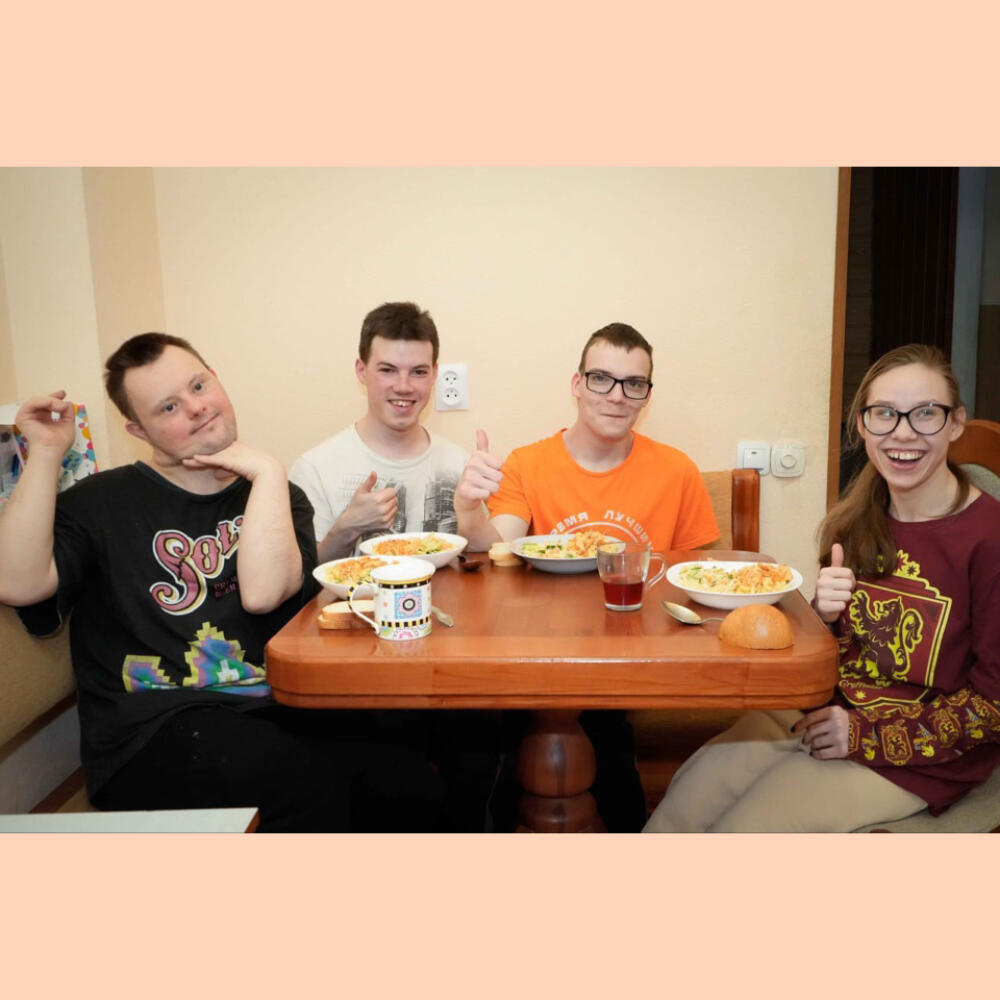
Currently, it consists of a complex of small residential communities for people with disabilities, offering everyone access to work, cultural activities, and adapted professional education – as an alternative to Russia’s closed institutions. Through the “Assisted Living” project, individuals already living at “Blagoe Delo” and people from state institutions are given the opportunity to live independent lives. They learn everything from taking care of an apartment to shopping, cooking, navigating public transportation, and visiting cultural institutions, among other things. Currently, 14 people are receiving this support. Two families have already formed, both of which have been able to purchase their own apartments.
The city government, which had provided an apartment, also helped renovate one of the beautiful, old log cabins located in the city. That building is now Blagoe Delo’s cultural center. For several years now, Blagoe Delo has also been renovating another beautiful historic wooden house, which is planned to serve as a residence for seven residents. Unfortunately, construction work is being delayed and complicated by the current situation, which has made everything much more expensive.
The Blagoe Delos Cultural Center offers opportunities for artistic activities and studies. It hosts theater performances, concerts, exhibitions, and film screenings, and annual festivals are now celebrated there as well. Visitors also have the opportunity to organize performances in collaboration with professional artists and students from the theater school. The cultural center is now an integral part of the community and is open to all residents, the nearby city of Novouralsk, and anyone else who is interested.
Behind all of this lies Blagoe Delo’s invisible yet very tangible source of strength – the entire noble group of people who, over the past 20 years, have sought and received help and have found their place as key, meaningful contributors. There are passionate individuals like Vera Simakova, Petter Holm, and a long-standing, loyal group of collaborators. There are also the mothers who themselves have a daughter or son with special needs.
We are slowly beginning to see positive changes in society regarding the situation for people with disabilities. A new law makes it possible for people working in workshop facilities to receive a wage through various arrangements. The chances of finding a job have increased. Efforts are being made to make the environment more accessible. There are now also foundations that support nongovernmental charitable organizations. Government support for “Blagoe Delo” has improved significantly, even if it is not comparable to conditions in the Nordic countries. Still, basic support is guaranteed. It is clear that “Blagoe Delo,” together with similar organizations, their cultural festivals, and, not least, the World Congress, has contributed to this positive development.
“We miss each other – our inspiring exchange of experiences, our adventures, our songs, our laughter. We miss each other as the friends we were and will always be, no matter what happens. Just as it’s always been, we’re doing what we can under the circumstances,” two of our key staff members wrote recently.
And what can we do “under the circumstances?”
“When you feel warmth in your heart, you’ll remember us.”